Wayfinders
Center for Collaborative Learning

Wayfinder
Someone who navigates uncharted and often complex territory without a map (sort of like every single day of being a parent and every single day of being human).
Teaching is hard. I know what it is like to care deeply for each and every one of your students, and to feel like you are drowning without the resources your students need in order to thrive.
Parenting is hard. I know the magic, exhaustion, frustration, and joy of parenting, and the ways that experience is intensified if you are raising a neurodivergent kiddo.
And being neurodivergent in a world not built by or for neurodivergent minds can be especially hard. As a lived-experience practitioner, I live it every day.
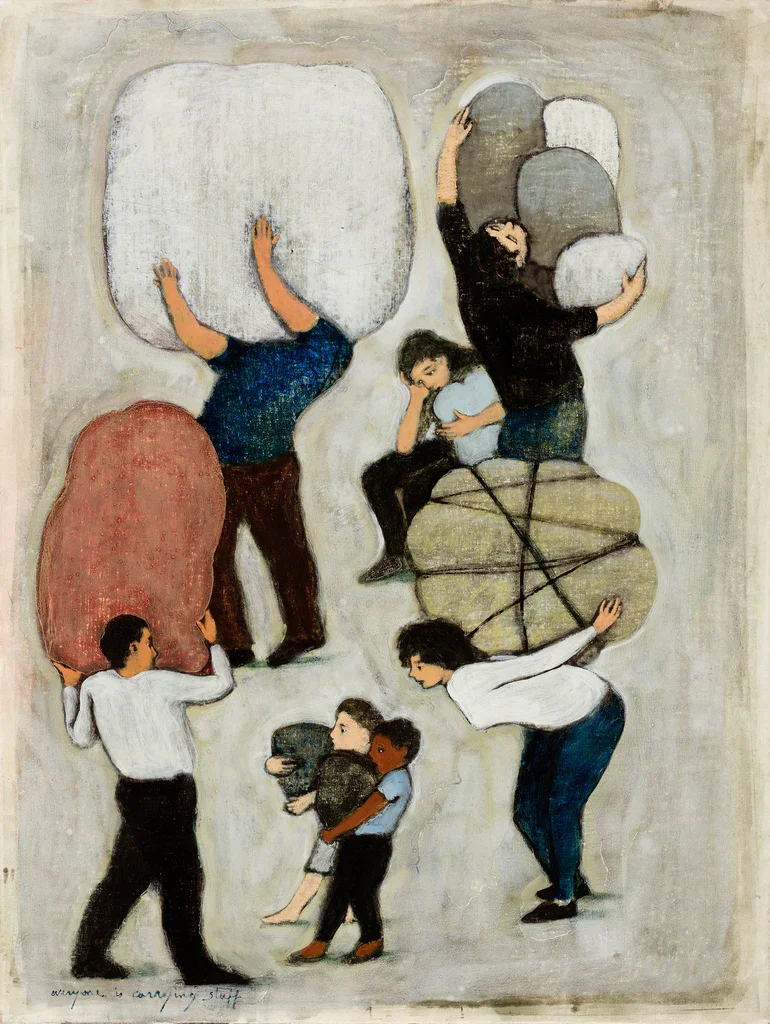
Artwork created by Brian Kershisnik. Click image to purchase or learn more about the artist.
I see YOU.
I hear YOU.
Your journey MATTERS.
As a “lived-experience” learning specialist, family coach, and professional development facilitator, I offer “neurodivergent-affirming” support that centers on compassion, understanding, and growth.
I partner with students, families, and educators to build community, strengthen skills, and create systems that truly work for the way each brain learns and lives.
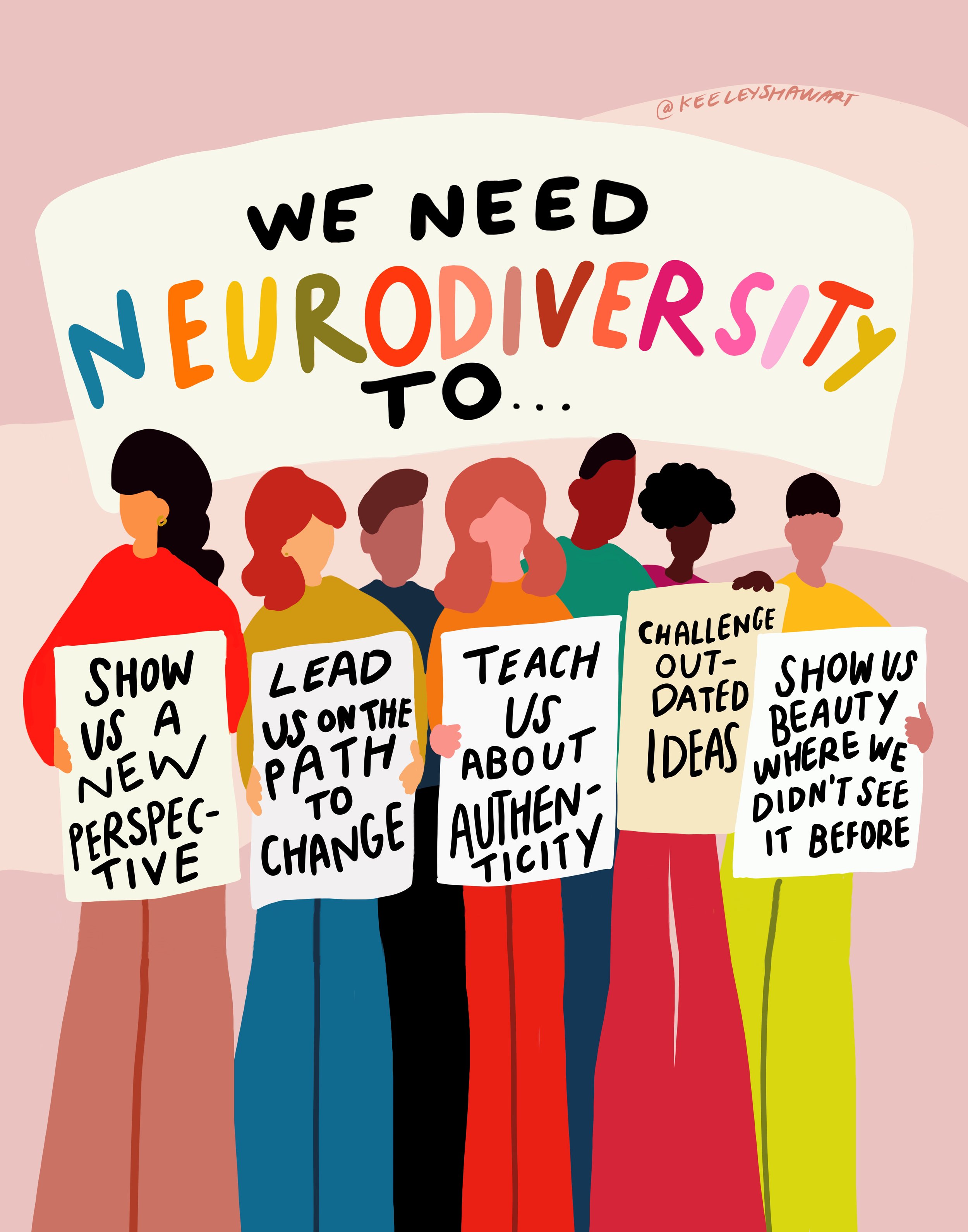
Art created by Keeley Shawart. Click image to purchase or learn more about the artist.
Not familiar with some of the terminology I am using? No worries… scroll down to learn more.
Not sure if your child is “neurodivergent”? We don’t need a label to support your child and family.
Ready to find out more about me and the services I provide? Scroll up to the menu on my website to learn more.
What is “neurodiversity”?
Neurodiversity means that some brains do not have the same wiring as what society has defined as the “norm”. In the same way that a forest is healthier and stronger when it has variations within its species of trees, flowers, and creatures… our communities are healthier and stronger when they fully include and value people who think, learn, move, and feel in different ways.
Depending on the wiring of your brain, you may thrive best in different conditions or very specific conditions.
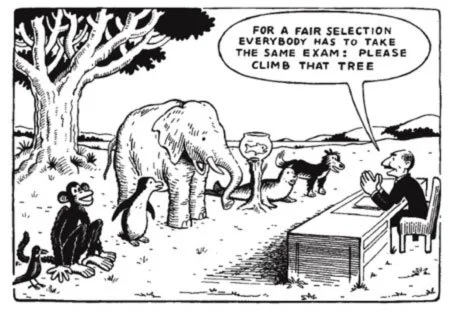
Comic created by Barry Linton
A fish is not lazy or fundamentally flawed because it cannot climb a tree. It is designed to thrive in a specific ecosystem. The ecosystem, not the fish, is what needs to change.
Some examples of “neurodiversity” may include:
-
Autism is a natural variation in how a person's brain is "wired," affecting how they perceive the world, process information, and interact with others. Autistic individuals may:
Communicate and socialize differently than what modern society has determined to be “the norm”.
Have strong, focused interests (sometimes called "special interests") that bring joy and deep knowledge.
Often prefer predictable routines and might get distressed by unexpected changes.
Experience sensory input (sights, sounds, textures) more intensely or less intensely than others.
-
ADHD is a neurodevelopmental condition that affects a person's executive functioning skills (the brain's "management system"). People who experience the world through ADHD may:
Experience difficulty sustaining “on-demand” attention based on someone else’s priorities.
Have an abundance of energy or a need to move their bodies to engage their brains.
Demonstrate an abundance of creativity, the ability to "hyperfocus" on high-interest tasks, and innovative problem-solving skills.
-
Dyslexia is a common learning difference that primarily impacts some areas of reading development and related language skills. It's a different way the brain processes language, not a measure of intelligence. A person who learns through dyslexia may:
Experience challenges with reading print and spelling.
Display strengths in areas like creative thinking, problem-solving, and visual or spatial reasoning.
Demonstrate discrepancies in different areas of reading development. For example, may excel in comprehension and vocabulary with the accommodation of audiotext, but may struggle significantly to decode words in print.
-
Dysgraphia is a learning difference that makes the physical and/or mental process of writing challenging. It affects motor planning and the ability to organize thoughts on paper. Individuals with dysgraphia may:
Struggle with handwriting, finding it tiring or difficult to make letters clearly.
Have trouble organizing their written ideas, even if they can express them well verbally.
Be very bright and articulate, but their writing does not reflect their intelligence.
-
Dyscalculia is a learning difference that makes some math-related tasks difficult. Similar to how dyslexia affects language, dyscalculia affects a person's "number sense." A person with dyscalculia may:
Struggle to understand numbers, remember basic math facts, or solve multi-step problems.
Have difficulty with tasks like counting money, telling time, or estimating distances.
Do their best work as mathematicians when they can “see” and “touch” their math, or in concrete areas of math like graphing meaningful data.
-
Twice exceptional, or 2e, is a term for individuals who are identified as both “gifted” (often determined by cognitive testing) and have a neurodivergent profile (such as autism, ADHD, or a learning difference like dyslexia).
Their high intellectual abilities often mask their challenges, or their challenges mask their giftedness, making them sometimes misunderstood.
They may show exceptional creativity or problem-solving skills, while simultaneously struggling with organization, social interactions, or specific academic tasks.
2e learners need support that nurtures their exceptional talents and accommodates their learning differences.
These examples are not exhaustive and are not reflective of every individual experience.
Language is one way to describe and attempt to understand the identities and lived experiences of other people.
AND
Language also has its limitations. We are each called to be mindful of the ways that language can oversimplify, stereotype, or label another person’s identity or lived experience.
What does “Neurodivergent-Affirming” mean?
“Neurodivergent-Affirming” means honoring neurodivergence as a necessary variation in how brains work and experience the world… celebrating the strengths… and supporting the struggles.
What is a “lived-experience” practitioner?
A “lived-experience” practitioner is someone who personally identifies in the same areas that they are also professionally trained to support. For example, I am professionally trained as a learning specialist who supports neurodivergent students, AND I identify as neurodivergent. I am also a parent of two kiddos, one of whom is neurodivergent, AND I support families who are raising at least one neurodivergent kiddo.
This can be especially helpful when you are seeking someone with a high level of professional experience and training who also “gets it” from their own everyday journey.